
[R&D] >
새로운 Framework
소유 메시
비싸면서 자주 사용하지 않는 상품일수록 메시 전략이 성공하기 쉽다.
신뢰의 순환주기 데이터가 붕부하고 공유 가능성이 높은 상픔과 서비스가 메시 사업 품목으로 가장 적절하다.
|
customer experience framework-크리베이트 접목한다면?
In helping a client understand how to reframe their internal conversations to support delivering customer experiences, we shared with them the following framework that has helped our thinking. Systems: Companies have core systems that serve as the foundation for their efforts. The most obvious example are IT systems — ERP, accounting, CRM, and the like. Perhaps less obvious, but in certain cases quite crucial, would be facilities — such as real estate, architecture, and infrastructure. Procedures: The policies, processes, and business rules that provide the "logic" for how the business is run. Some of this is embedded in the systems, some of this is taught to employees. Touchpoints: The liminal spaces where engagement with customers occurs. Typically considered through channels such as in-store, call center, postal mail, or online. Experiences: The sum of what the customer takes away from the interactions they've had with you. Many companies don't intentionally plan their customer experiences, and as such, design from the inside-out.
This is particularly true when companies consider CRM initiatives. One would hope that something focused on "customer relationships" would take the customer to heart when being developed. Instead, as Edmund Tribue points out, "Most companies have concentrated on automating processes for their internal users... But what about the customer? This mindset is perfectly illustrated by the most common CRM objectives: increase sales, drive cross-selling, minimize resources, reduce ancillary expenses, and lower the number of costly channel interactions. Those objectives indicate an inside-out view that implicitly treats the processes and internal metrics as more important than the customer." Customers have no idea what's going on in those layers below "interactions", and just end up feeling insulted and abused by these mercenary mindsets. Instead, companies need to identify what makes for a delightful customer experience, and coordinate their interactions, touchpoints, procedures, and systems to support that.
This harkens back to the my last post about Target's ClearRx. By starting with a prototype, an embodiment of an experience, Target was then able to align the appropriate interactions, touchpoints, procedures, and systems that would support it. And as the Target story pointed out, it's not a one-way street. Reasonable limitations with the systems, regulatory restrictions on procedures, those are going to ripple back up and ultimately affect the experience. But by beginning outside-in, you make better decisions when you deploy from the inside-out. (Thanks to my colleague Brandon Schauer whose work helped shape this article.) |


by Klien
  Presentations...how forgettableIt appears that about 10 minutes is the natural attention span of the average adult (20% of the average presentation).
|

compelling experience model
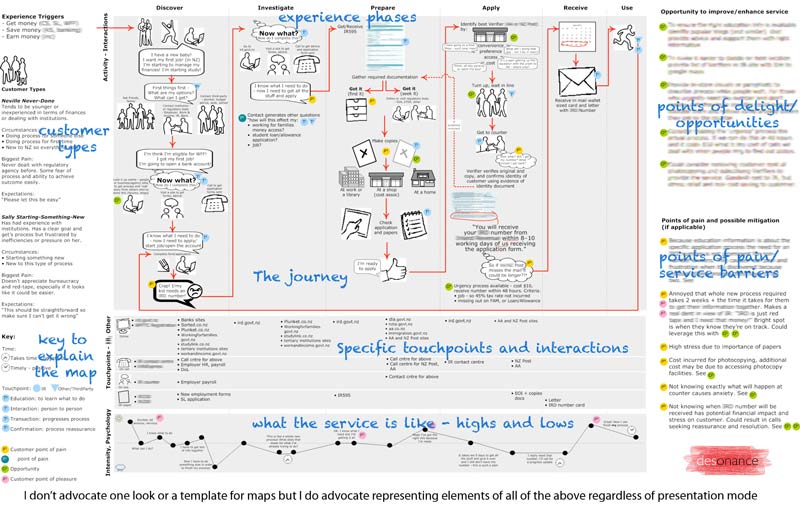
 Frameworks are a means of structuring thinking and research findings into a format that is meaningful to the desired change; they offer deeper understanding and turn abstract information into meaningful categories and relationships. It’s best captured in a quote from Conifer Research where they called “[frameworks and models] scaffolding when we build Experience Maps”. 사고를 구조화하고 리서치 결과물을 포맷으로 만드는 것. 포맷은 향후 만들 때 의미 있는 것. 이렇게 프레임으로 정리되면 이해가 깊어지고, 추상적인 정보가 의미있는 카테고리와 관계로 바뀜. A framework for frameworks Experience Maps and Service Blueprints are forms of frameworks so when I was working on developing the techniques I needed a way of describing how you organised existing and created information before you could map it. I developed this framework (the purpose of which is to contextualise):
When frameworks become a map Frameworks tend to be set in concrete in terms of content (i.e. once they’re developed they shouldn’t change. NB: this isn’t the case for maps). There may/should be many different frameworks to capture facets of information. At the user experience level:
Frameworks become a map when you want to plot a journey and the map helps you ‘see’ service as a whole; the map humanises meaning from the abstracted frameworks. Framework Hall of Fame I’d like to thank these frameworks for helping me sleep through the night when panic set in about how the hell I was going to articulate experience, helping me work more quickly, and most of all, for helping making meaning of mass.
A way of breaking down user experience. I have never been able to come up with a better definition of experience in relation to service design than this framework.
The following frameworks I relied on heavily in capability development
And just to show designers aren’t anti Business Analysis, this helped me engage with my BA colleague on many an occasion.
|


| Attachments:  doblin_framework.eps
project framework
 figuring out what I need to make + gather in addition to how everything is going to be presented The reason I made this visual was to figure out how users would be able to progress through the final piece, when and how they would be viewing the information, and also what I needed to start creating. Of all the brainstorming methods I’ve used so far, this is probably the simplest and most effective in explaining how I’m going to attack this project and will really help when I get down to piecing everything together. |
| Attachments:  project framework.png


